
It can happen that a building suffering from rising damp begins to show whitish marks on its surface. These marks are a warning sign that saltpetre is present and should not be taken lightly.
What are the causes and solutions for getting rid of saltpetre before it deteriorates the quality of your home? These questions will be answered in the rest of this article.
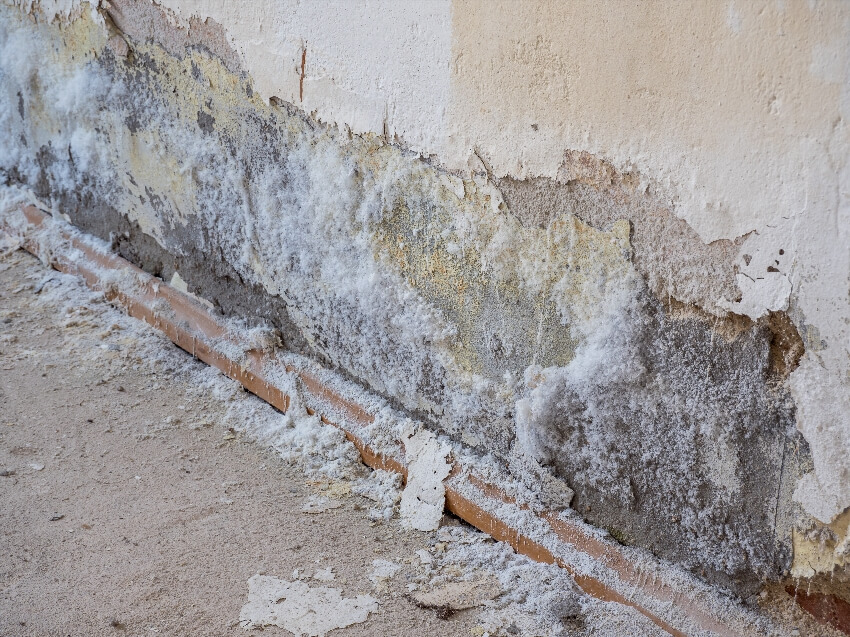
What is saltpetre and where does it come from?
Saltpetre is a whitish, sometimes greyish, substance that often develops at the base of building walls. However, when the problem is more serious, saltpetre can develop up to 1.50 meters above ground level. Even more problematic, saltpetre can affect the foundations of a structure.
Saltpetre consists mainly of nitrate and potassium. It results from a chemical reaction caused by moisture mixed with organic substances.
It forms mainly as a result of capillary rise. This phenomenon is due to the upwelling of groundwater laden with decomposing organic matter in the porous matter of building materials. As the air comes into contact with the walls and the moisture evaporates, only a whitish deposit remains: saltpetre.
But saltpetre can also form in other ways, usually due to poor ventilation inside a building. It’s not uncommon to find saltpetre in cellars, kitchens, bathrooms, etc.
How to detect saltpetre and why?
Saltpetre is not a phenomenon to be taken lightly, and for good reason: its presence can be highly problematic. So, at the very first suspicion, it’s important to get to grips with the problem.
To do so, simply detect the presence of significant whitish or grayish deposits on the walls. It’s worth noting that saltpetre is sometimes accompanied by mold and small fungi.
Indoors, the presence of saltpetre can be revealed by peeling wallpaper or crumbling material on walls.
Another very significant sign is the presence of cracks in the walls, a sign of more or less serious deterioration, depending on their severity.
The reason why it’s so important to diagnose the development of saltpetre so quickly is that it can have far-reaching consequences for a building. Here are just a few examples:
- Saltpetre can accelerate the deterioration of both internal and external wall finishes.
- It can create a harmful unhealthy situation and have an impact on allergy sufferers.
- The appearance of fungi and molds can cause health problems and lead to respiratory pathologies in over-exposed individuals.
- It can also cause serious digestive problems if accidentally ingested by pets or young children.
In short, saltpetre in the home is a real problem that needs to be dealt with as quickly as possible.
How do you deal with saltpetre?
The most urgent thing to do when a saltpetre problem is detected is to contain its development. The best way to do this is simply to remove the visible material. Next, sand the surface with a wire brush or sander to sanitize the affected area. The third step is to apply a damp-proofing paint, an anti-saltpetre product or a surface water repellent.
Once the problem has been contained, it’s important to get to the source and eradicate it completely. Indeed, if nothing is done, saltpetre will always reappear on the surface of walls. Let’s face it: as long as there’s moisture in the building, saltpetre is bound to form.
When it comes to basic treatment, it’s always advisable to call in a specialist company. This allows the problem to be treated in its entirety and prevents its systematic recurrence.
Some examples of basic treatments for saltpetre :
Professionals who treat saltpetre have a number of solutions at their disposal to deal effectively with this scourge. In general, the aim is to treat the problem of rising damp and/or poor ventilation at source.
Here are a few examples of capillary rise solutions:
- Drainage of floors or walls in the affected building using a groundwater drainage system.
- Drying out walls by evacuating moisture.
- Laying a waterproofing membrane along damp wall(s). This stops groundwater rising through capillary action.
- Injecting resin or silicone directly into the walls concerned, using special syringes that block capillaries and act deep down.
- And sometimes casing.
In the case of ventilation problems, the following solutions can be proposed:
Ensure better ventilation with air extraction systems such as VMS (simple mechanical ventilation). The aim is to renew the air in a room by installing a motorized system. Other similar systems include VMR (distributed mechanical ventilation) and VMI (reverse mechanical ventilation).
The installation of a Canadian well, which uses geothermal energy to optimize building ventilation. The aim is to use the temperature of the ground to heat or cool the ambient air.
In conclusion:
Saltpetre is a serious problem which, in addition to causing problems for buildings (surface and structure included), can also have repercussions on the health of inhabitants.
That’s why, once the problem has been diagnosed, it’s always a good idea to call in a professional to find an effective, lasting solution.
Because saltpetre thrives best in damp, poorly ventilated rooms, it’s important to ensure that the air is regularly renewed. A simple, effective habit that should keep saltpetre at bay for as long as possible.


