
Insulating the walls of your home is a must, as it improves both heat and sound insulation. No more heat loss in winter, and savings on heating costs. But can you do the work yourself, or should you call in a craftsman? And how do you go about insulating the outside walls of your home?
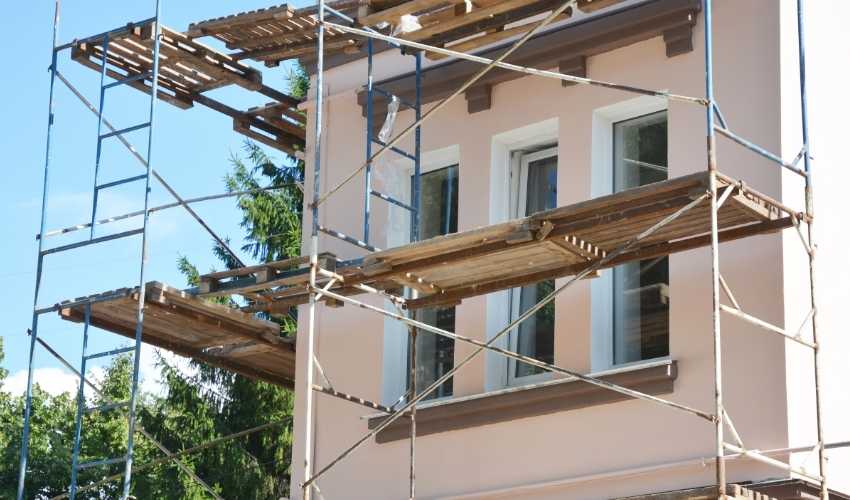
What precautions need to be taken before insulating the outside walls of your home?
Long-lasting insulation
As well as saving energy, insulating the exterior walls of an old house during renovation, for example, reduces its carbon footprint. While it’s easy to buy insulating panels from Castorama, Lapeyre and other DIY stores, it’s important to understand how the walls of an existing house are built and how they “work”. Thermal insulation is indeed important, but so is maintaining humidity levels. The aim is to do work that lasts, which is why wall insulation needs to be taken seriously.
Insulation that lets moisture escape
Before installing insulation on the outside of the house, it’s important to study the climatic zone in which the dwelling was built. Condensation points must be absolutely avoided in the wall assembly, so as not to prevent internal moisture from escaping. In this way, the wall structure can dry out and remain healthy. This is why walls must be built to meet the specific climatic requirements inherent to their location. We’ve already seen disasters involving the installation of interior vapour barriers on air-conditioned houses in hot, humid regions…
What are the different types of insulation?
The thicker the walls, the greater their protection. Today, for new buildings, the law requires walls to be between 14 cm and 16 cm thick. This is why we recommend insulating the house from the outside. This means losing a little living space, but with optimum comfort. It’s also worth noting that some types of insulation perform better than others, depending on wall thickness.
Mineral insulation
Glass or rock wool mineral insulation offers good acoustic insulation. Easy to install, it’s light and flexible. It does, however, require a little experience to prevent moisture from penetrating. Another advantage is that it is non-combustible.
Synthetic insulation
3 synthetic insulating materials are suitable for insulating the exterior walls of your home:
- extruded polystyrene
- expanded polystyrene
- polyurethane
They are in the same price range as mineral insulation. They are easy to install, but cable management is rather complicated. It’s worth noting that sound insulation is less effective, unless you use a specially reinforced insulator to make up for this shortcoming. Warning: as a petroleum derivative, synthetic insulation is flammable.
Thin insulation
There are several types of thin insulation, with uneven performance. Difficult to install, they present risks of condensation. They are certainly thinner than other types of insulation, but the gain in wall width is relative. An air gap must be left between the wall and the insulation. Alternatively, there are now high-performance products that can be installed directly on the wall, but these are still innovative and rather expensive. Unless you’re an experienced do-it-yourselfer, or are accompanied by a professional, it’s best to entrust the installation of this type of insulation to an experienced craftsman. It’s a fairly technical product, and its insulating performance depends enormously on the way it’s applied.
Biobased insulation
Derived either from nature, or from recycled textile- and paper-based materials, this type of insulation can be :
- wood fiber
- textile panels
- a mixture of hemp, linen and cotton
Barely more expensive than mineral insulation, bio-sourced insulation is becoming increasingly popular. For the same performance, they are gaining ground because they put local businesses to work. They have a definite advantage over other types of insulation: they breathe more easily and better regulate humidity in the home. And not least, they offer the best thermal phase shift (the time it takes for heat or cold to pass through the insulation barrier and enter the house) of all insulating materials, lasting several days. They are particularly well-suited to timber-frame houses, but are also suitable for concrete ones.
Are there any grants for home insulation?
How can I benefit from these MaPrimeRenov’ grants?
The French government has introduced new laws concerning energy renovation. The main condition for benefiting from this financial aid is to use craftsmen who are “Reconnus Garants de l’Environnement” (RGE). This implies that they have undergone specific training and signed a charter certifying that their work is designed to improve the energy performance of the home.
How much financial assistance is available?
These schemes significantly reduce the cost of thermal insulation work, as well as replacing windows with energy-efficient models, for example. All households are entitled to an energy voucher. The amount is proportional to the estimate provided by the building professional, and also to the income of the homeowner.
In practical terms, how do I apply for these grants?
It’s quick and easy! Just go to https://faire.gouv.fr and fill in the form. To complete the application, you’ll of course need a quote from an RGE craftsman.
Home insulation is important for 3 reasons:
- It helps protect the environment
- It means substantial financial savings over the year.
- A house with a well-insulated facade sells for more!