
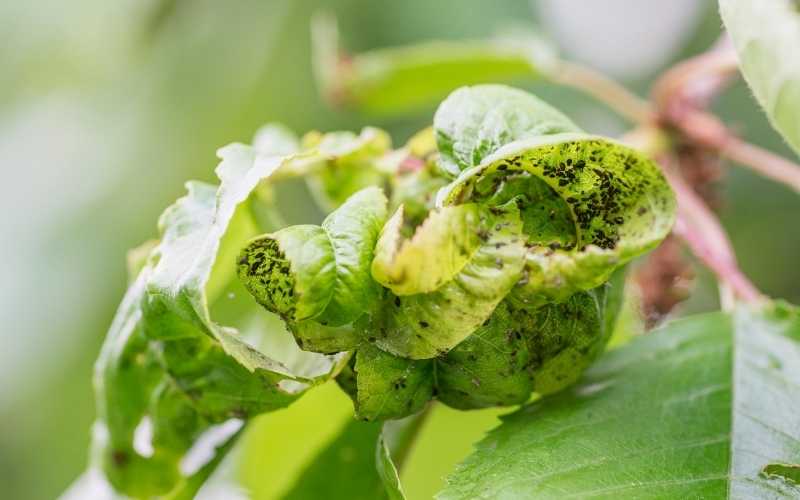
As all amateur and experienced gardeners know, aphids are a real nuisance when they invade gardens. These little pests are capable of attacking just about every plant in the garden.
The main problem with these bugs is that they have a real impact on plant development. So it’s important to get rid of them as quickly as possible.
While there are many chemical insecticides that can do the job, there are also many totally natural solutions that can effectively get rid of aphids.
These natural solutions are much healthier for our health and the environment, which is why it’s best to focus on these methods. Here are a few of the most effective.
Ladybugs, the aphid predator
Aphids are one of ladybugs’ favorite meals. So, to get rid of them, there’s nothing like introducing ladybugs into your garden. All you need to do is buy some larvae.
As adults, ladybugs are capable of killing up to 250 aphids a day. A few ladybugs are therefore effective in eliminating a colony of aphids.
Be careful, however, when choosing larvae, as you should never opt for “Harmonia axyridis” ladybugs. This species of Asian ladybug is a predator that also attacks other ladybirds.
Nettle manure to combat aphids
One of the most popular natural solutions for controlling aphids is to make nettle purin. All you need to do is :
- Chop nettle leaves and mix with rainwater, preferably. The ratio is 100 grams of nettles to 1 liter of water.
- Leave the mixture to macerate for 15 days, stirring twice a day.
The puree can then be sprayed onto infected plants. Watering diluted to 20% will prevent the return of pests.
Planting and using wormwood
Wormwood is an aromatic and medicinal plant that acts as an aphid repellent. Planting wormwood at the foot of garden plants helps prevent the spread of aphids.
Wormwood can also be made into a decoction by macerating 100 grams of leaves in 1 liter of water for 24 hours. After this time, the preparation must be boiled and left to cool completely before it can be sprayed on infested plants.
Making rhubarb macerate
Rhubarb macerate is one of the most effective solutions for killing aphids. It is even said to outperform most chemical insecticides.
To make rhubarb macerate, simply mix 500 grams of chopped rhubarb leaves in 5 liters of cold water. After standing for 24 hours, the mixture can be placed in a saucepan and brought to the boil.
The mixture can then be filtered and sprayed onto aphid-infested plants.
Garlic decoction to get rid of aphids
Garlic decoction is another highly effective natural solution against aphids, both as a preventive and curative treatment. To make it, simply boil 6 garlic cloves in 1 liter of water for a few minutes.
For optimum effectiveness, we recommend adding 4 drops of washing-up liquid to the mixture. This helps the product adhere to the plants.
Once ready, the preparation can be sprayed directly onto plants, to protect them or, on the contrary, to eliminate any aphids that may have clung to them.
If the aphid infestation is very advanced, you can repeat spraying every 48 hours until the aphids have completely disappeared.
Black soap, excellent for killing aphids
Aphids are pests that can be easily eradicated with the clever use of black soap. To prepare, simply dilute 20 cl of soap in 1 liter of water.
The resulting solution can then be sprayed onto infested plants. The next day, the aphids are eliminated. It is then advisable to repeat the operation at least once a month to prevent the appearance of new insects.
Be careful: when using this solution, plants must be rinsed with clean water after 24 hours to avoid damaging them.
Tobacco to get rid of aphids
A little-known but nonetheless effective trick: tobacco to eliminate aphids. Once again, a simple macerate is made by infusing brown tobacco in water for 24 hours, at a ratio of 100 grams of tobacco to 1 liter of water.
Smokers can also use cigarette ash mixed with water. In both cases, the resulting solution can be sprayed directly onto plants, quickly eliminating aphids.
Fern slurry, an effective aphid repellent
Like nettle, it’s also possible to make a fern slurry. Unlike nettle, this plant can be handled without gloves.
To make fern slurry, chop 300 grams of leaves and macerate in 2 liters of water for 10 days.
Once filtered, this natural insecticide will kill aphids in a single spray. However, if a few aphids resist, a second application can be made. In principle, no aphids will resist this second wave.
As a preventive measure, you can apply one spray per week.
Using washing-up liquid as an aphid repellent
No time to make a macerate? No problem! With washing-up liquid, a product that everyone has in their kitchen, you can make an effective insecticide against aphids.
A simple teaspoon of dishwashing liquid in half a liter of water will get rid of stubborn aphids.
Organic dishwashing liquid is preferable, and it’s important to spray only the upper part of the plant, so as not to interfere with root development.
Olive oil as an aphid repellent
Olive oil is another good aphid repellent, and one that everyone often has in their cupboards. To use it, simply mix 2 heaped tablespoons of oil in 1/2 liter of cold water and spray the solution on the plants concerned.
For a formidable insecticide, you can make a mixture based on :
- 1 glass olive oil
- 3 tablespoons turpentine
- 1 liter of tobacco macerate or cigarette butt juice (a solution obtained by macerating cigarette butts in water for several months).
Nasturtium seeds in the garden
Nasturtium seeds are an effective aphid trap. Sowing nasturtium seeds in the garden prevents plants from being targeted by aphids, which prefer to concentrate on the seeds.
Eliminate ants to get rid of aphids
Ants are a problem in the garden when they start breeding aphids. Blocking the ants’ access prevents plants from becoming infested with aphids. You can use strips of glue, sticky flycatchers or double-sided tape to trap ants before they get to your flower beds and vegetable garden.
Planting matches in the ground, an effective grandmother’s trick
Sulphur-based matches are an excellent aphid repellent. To put this trick into practice, simply plant a few matches directly in the soil near plants exposed to aphid attack.
Note that it’s the “head” of the match that needs to be planted, not the stem. A particularly effective tip for potted plants.
And here are no less than 13 effective tips to get rid of aphids in the garden.


